If your feed is full of student-loan panic, slow down. The July 1 changes are real, but they do not mean every federal borrower needs to make the same move this week.
Two new repayment options are now live for borrowers with new federal student loans: the Repayment Assistance Plan, usually shortened to RAP, and the new Tiered Standard repayment plan. On top of that, the U.S. Department of Education announced a temporary auto-pay incentive that can raise the usual federal student-loan interest-rate reduction to a full 1% for eligible borrowers.
That is the headline. The more useful question is smaller: which part of this actually applies to your loans right now?
Quick facts for the July 1 student-loan changes
- Live start date: July 1, 2026.
- New plan options: RAP and Tiered Standard.
- Who gets immediate access: Borrowers with new federal student loans, according to the Education Department fact sheet.
- Transition window for some existing borrowers: Through July 1, 2028.
- Temporary auto-pay break: Up to a 1% interest-rate reduction beginning July 1, 2026.
- Auto-pay enrollment deadline for the temporary full reduction: September 30, 2026.
- Temporary full-reduction end date: June 30, 2028.
- Verification path: StudentAid.gov plus your servicer account.
What changed on July 1
According to the Education Department's June 9 fact sheet, the repayment system is being simplified into two main new choices for affected borrowers: RAP, which is the new income-driven option, and Tiered Standard, which is a fixed-payment option with longer terms based on total borrowing.
The department says borrowers with new student loans can access these plans starting July 1, 2026. It also says the StudentAid.gov application takes about 10 minutes, and borrowers who consent to direct IRS tax-information retrieval may not need to upload income documents manually.
For a lot of borrowers, that means the first move is not switching plans blindly. It is confirming whether the new-plan rules actually touch their account.
The new auto-pay interest-rate reduction
The biggest fresh detail in the July 1 update is the auto-pay announcement.
The Education Department says federal student-loan borrowers enrolled in auto pay are eligible for a 1% interest-rate reduction beginning July 1. Borrowers who are already enrolled do not need to take any action. The department says servicers will automatically add an extra 0.75% reduction on top of the usual 0.25% auto-pay discount, bringing the total temporary reduction to 1%.
Borrowers who are not yet in auto pay can still get the full temporary reduction, but the department says they need to enroll by September 30, 2026 to receive it through June 30, 2028.
The announcement also says the extra reduction applies to borrowers whose Federal Direct Loans originated after July 1, 2012, including eligible student and parent borrowers. Borrowers in default must first log in to StudentAid.gov, consolidate eligible loans, apply for a new repayment plan, and then enroll in auto pay once their loans return to good standing.
This matters, but it is still a verify-first update. Do not assume a viral screenshot is more accurate than what your own borrower dashboard shows.
Who should check right away
Not every borrower has the same urgency this week.
Borrowers who should log in soon include:
- People taking out new federal student loans and wanting to understand their default repayment choices.
- Borrowers who think they are in a phased-out repayment plan and want to compare RAP, Tiered Standard, and IBR.
- Borrowers who are not enrolled in auto pay and want to confirm whether they qualify for the temporary 1% reduction before the September 30 deadline.
- Borrowers in SAVE or another plan now described by the department as phased out or in transition.
Borrowers who should avoid panic clicking include:
- People assuming they were automatically pushed into a brand-new plan without checking loan dates.
- People copying advice from posts that never explain whether the borrower has a new loan, an older loan, or a defaulted loan.
- People treating a temporary interest-rate incentive as a substitute for understanding the repayment plan underneath it.
How RAP works in plain English
RAP is the main attention magnet because it is the new income-driven plan in the July 1 package.
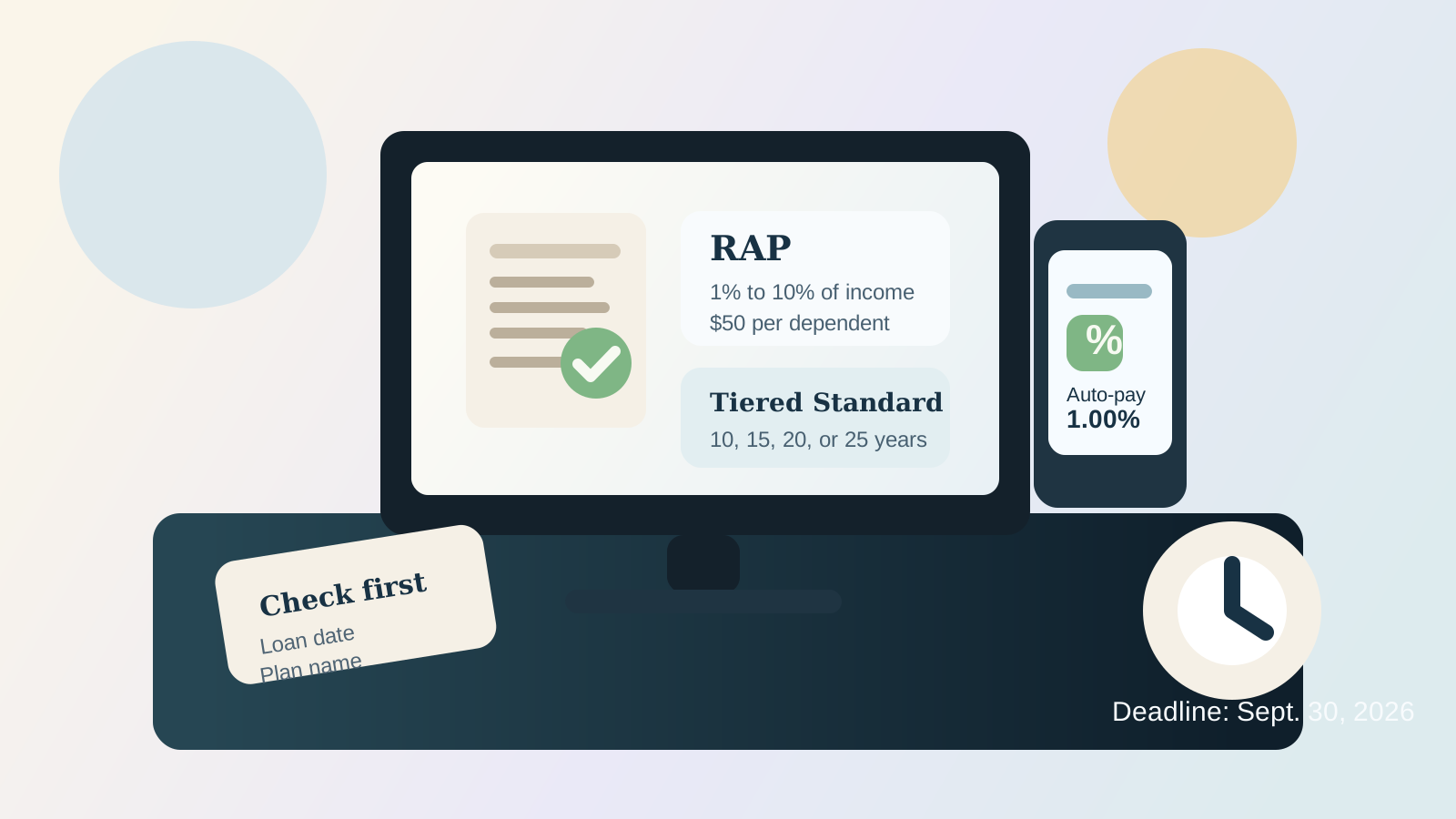
The Education Department says RAP monthly payments run between 1% and 10% of a borrower's income, depending on earnings. It also says payments are reduced by $50 per month for each dependent.
The borrower-facing promise is what happens after an on-time payment:
- Remaining unpaid monthly interest can be waived.
- If your payment does not reduce principal by at least $50, the department says it can add a matching principal payment of up to $50.
That matters because many borrowers are used to balances that barely move. The department's RAP pitch is that on-time payments should do visible work.
The fact sheet also says RAP can still lead to discharge in limited cases if a borrower has a remaining balance after 360 monthly, on-time payments.
How Tiered Standard is different
Tiered Standard is quieter, but it matters for borrowers who do not want an income-driven plan.
Instead of putting everyone into the same 10-year standard structure, the new Tiered Standard plan offers repayment terms of 10, 15, 20, or 25 years based on the amount borrowed. The tradeoff is straightforward: a longer runway can lower the monthly bill, but borrowers should compare the full repayment shape, not only the first monthly number they see.
For borrowers who want predictability without income recertification, this may be the easier place to start.
What existing borrowers should not assume
This is the part rushed posts keep flattening.
The June 9 fact sheet says certain borrowers currently enrolled in phased-out repayment plans with loans made before July 1, 2026 have until July 1, 2028 to decide between RAP, Tiered Standard, or IBR. That means some existing borrowers may have breathing room to compare options and avoid same-week mistakes.
If your loans are older, the safest move is not guessing. It is verifying:
- When your loans were made.
- Which repayment plan you are in right now.
- Whether the transition rules actually apply to your account.
- Whether your servicer has sent an account-specific notice.
- Whether auto pay is already on or still needs to be set up manually.
What to do today
- Log in to StudentAid.gov.
- Confirm whether your loans are new or were made before July 1, 2026.
- Check your current repayment-plan name instead of relying on memory.
- Read any fresh message from your servicer.
- If you want the new auto-pay break, confirm whether your loans qualify and whether you are already enrolled.
- Compare RAP, Tiered Standard, and IBR only after you know which options actually apply to you.
- Save screenshots or PDFs of important account pages.
- If you are borrowing for an upcoming term, ask your school's financial-aid office for written guidance tied to your situation.
FAQ
Do I need to switch repayment plans this week?
Not necessarily. The Education Department says borrowers with new student loans can access RAP and Tiered Standard starting July 1, but certain borrowers in phased-out plans with loans made before July 1, 2026 can have until July 1, 2028 to decide among RAP, Tiered Standard, and IBR.
Is the new 1% auto-pay interest-rate reduction permanent?
No. The department says borrowers who are already enrolled in auto pay, or who enroll by September 30, 2026, can receive the temporary 1% reduction through June 30, 2028.
Do borrowers already in auto pay need to sign up again?
No. The July 1 announcement says borrowers who are already enrolled do not need to take any action and should receive the additional 0.75% reduction automatically.
Is RAP available to every current borrower right now?
The June 9 fact sheet frames immediate access around borrowers with new student loans. Existing borrowers should verify whether the transition rules for phased-out plans apply before assuming they can or must switch right away.
What if my loans are in default?
The July 1 announcement says borrowers in default must first log in to StudentAid.gov, consolidate eligible loans, apply for a new repayment plan, and then enroll in auto pay after their loans return to good standing.
Where do I apply or verify what applies to me?
Start with StudentAid.gov and your loan servicer. If you are still in school or borrowing for an upcoming term, add your financial-aid office to that list.
Bottom line
The most useful student-loan takeaway this week is not the new acronym or the loudest post in your feed. It is knowing whether you have a new loan, an older loan in a phased-out plan, or a setup that makes the temporary auto-pay break worth checking right now.
Figure out that borrower bucket first. Once you do, the July 1 changes look more like a checklist than a panic spiral.
Sources
- U.S. Department of Education fact sheet on simplified student-loan repayment. Used for the July 1 launch timing, RAP payment structure, dependent reduction, unpaid-interest waiver, matching-principal detail, Tiered Standard terms, and the July 1, 2028 transition window.
- U.S. Department of Education announcement on the student-loan interest-rate reduction. Used for the temporary 1% auto-pay reduction, the September 30, 2026 enrollment deadline, the June 30, 2028 end date, and the defaulted-borrower path described by the department.
- StudentAid.gov. Used as the official verification and application destination referenced by the Education Department.