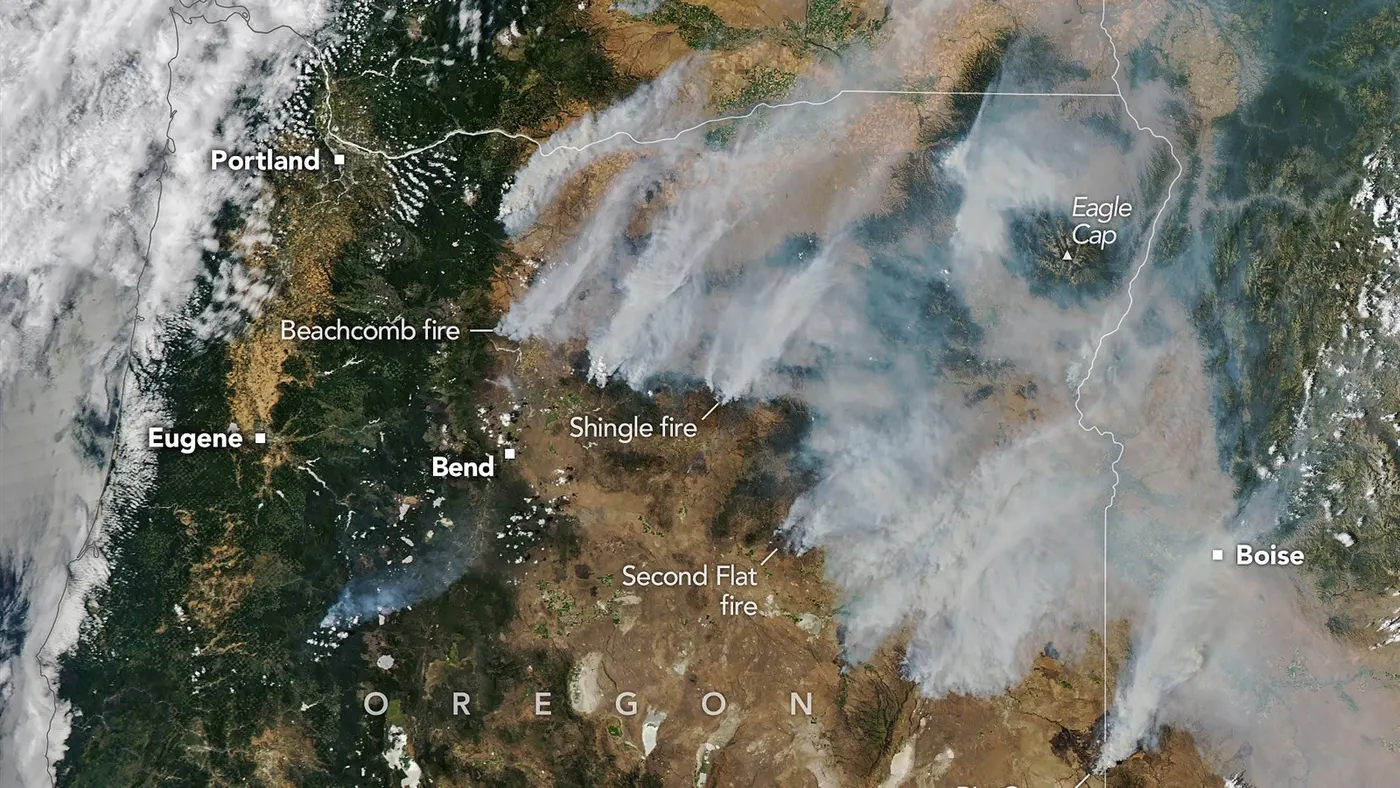
The smoke that turned Portland into one of the worst-air cities on the planet is finally starting to lift, but Oregon's record fire season is nowhere near finished, and the decision rule for outdoor plans has not changed for large parts of the state.
Here is the Aug. 7 transition in plain English: forecasters expect smoke to keep clearing from western Oregon and southwest Washington, with cooler relief arriving Friday and cleaner Pacific air pushing inland. At the same time, the Oregon DEQ air quality advisory for the Portland-Vancouver metro remains in effect until further notice, and a separate advisory issued Thursday covers dozens of central and eastern Oregon counties until further notice. The state still holds its modern acreage record, with more than 2 million acres burned across roughly 60 large fires.
This is the weekend-planning version of the smoke story. The question has shifted from "is it bad?" to "when is it actually safe again, and where?" Here is what the numbers say, who should still stay cautious, and how to make the final call.
The transition: what is actually happening Friday
The smoke story entered a new phase on Thursday and Friday. Winds shifted back toward the ocean, which started pushing the thickest smoke out of western Oregon and southwest Washington, and cooler marine air began moving inland.
What that means in practice:
- Portland and the Willamette Valley should see the most noticeable improvement, with a real clearing trend through Friday.
- Cooler relief is expected Friday after a stretch of near-100-degree heat, which removes the heat-and-smoke double problem for the metro.
- Smoke is not disappearing everywhere. The change in wind that clears western Oregon can push smoke into other areas, and central and eastern Oregon remain under a fresh advisory.
The honest part of the transition: a clearing sky in one neighborhood does not clear the whole state. Oregon's fire season still has roughly two months to run, new smoke can arrive with the next wind shift, and the record-acreage season is still generating smoke plumes. The useful habit stays the same: check the Fire and Smoke Map each morning and evening and plan around the trend.
Where DEQ advisories still apply
As of Friday morning, two active DEQ advisories matter for Oregon readers:
- Portland-Vancouver metro area (Clackamas, Multnomah, and Washington counties in Oregon, plus Clark County in Washington), issued Aug. 4, until further notice. The advisory also covers Baker, Benton, Columbia, Crook, Deschutes, eastern Douglas, Gilliam, Grant, Harney, Hood River, Jefferson, central and eastern Lane, Linn, Malheur, Marion, Morrow, Polk, Sherman, Umatilla, Union, Wallowa, Wasco, Wheeler, and Yamhill counties.
- Central and eastern Oregon, issued Thursday, Aug. 6, until further notice, covering Baker, Crook, Deschutes, Gilliam, Grant, Harney, Hood River, Jackson, Jefferson, Josephine, Klamath, central and eastern Lane, Malheur, Morrow, Sherman, Umatilla, Union, Wallowa, Wasco, and Wheeler counties.
"Until further notice" means exactly what it says: the advisory does not have a fixed expiration, and agencies will keep monitoring smoke as conditions change. A metro that looks clear in the morning can see smoke return in the afternoon if winds shift. That is why the check habit matters more than the advisory headline.
Why this season is still different
Oregon was already on track for an extreme fire season before this smoke event. As of the first week of August, the total area burned had passed 2 million acres, breaking the previous modern record set in 2024, with about two months of the season left. Roughly 60 large fires are burning across the state, according to OregonLive, KGW, and KOIN.
The smoke event that pushed Portland to the worst air among major cities this week was driven by a wind shift that carried smoke from those fires into the metro and much of the rest of the state, where it settled over a region also dealing with heat. Now the wind has shifted again, and that same weather pattern is what clears the metro while leaving interior counties smoky.
The record matters for a simple reason: this is not a one-week event. It is a season-long condition, and the same fires that filled Portland's sky this week can fill it again next week. Planning for smoke weeks is now part of summer in the Pacific Northwest, not an exception.
What the AQI numbers actually mean
The Air Quality Index is the EPA's color-coded scale for how safe the air is to breathe. When wildfire smoke is the problem, the number you are seeing is mostly driven by fine particle pollution, called PM2.5, tiny particles that can reach deep into the lungs.
The scale, in plain English:
- Green (0-50): Good. Normal outdoor plans.
- Yellow (51-100): Moderate. Most people are fine, but unusually sensitive people may notice symptoms.
- Orange (101-150): Unhealthy for sensitive groups. Children, older adults, people with asthma or heart or lung conditions, and anyone doing heavy outdoor exercise should start changing plans.
- Red (151-200): Unhealthy. Portland's readings sat in this range earlier this week. More people will feel it, and hard outdoor exertion should stop for most people.
- Purple (201-300): Very unhealthy. Outdoor time should be cut sharply for everyone.
- Maroon (301+): Hazardous. Stay inside as much as possible.
The color only matters relative to what you were about to do. Walking to the car is not the same as soccer practice, a 10-mile ride, or an outdoor work shift.
Who should still treat "unhealthy" as a hard stop
Even as the metro clears, red or worse readings remain possible in advisory areas, and the guidance is not subtle.
Treat outdoor time as a hard stop for:
- children and teens, especially at school or camp activities
- older adults
- pregnant people
- anyone with asthma, COPD, or other lung conditions
- anyone with heart disease
- anyone doing prolonged or intense outdoor work
If you are in those groups and AQI is red, move activities inside. If you cannot avoid being outside, keep it short, keep it easy, and pay attention to symptoms like a scratchy throat, burning eyes, coughing, chest tightness, or unusual fatigue.
For healthy adults, red air does not mean lock the doors, but it does mean cut the hard stuff. A quick walk is different from a tempo run or a long bike ride. This is the week to move workouts inside or drop the intensity.
Why one AQI number is not enough
A single number from a single sensor can mislead you in two directions, and that is especially true on a transition day like Friday.
First, conditions shift fast. Smoke can roll in by mid-morning and clear by evening, or the reverse. The reading from 7 a.m. may not describe the air at 3 p.m., and a clearing morning can still mean a smoky evening if winds turn again.
Second, air quality varies by neighborhood and by region. Valley floors, areas near fire lines, and spots downwind of active burning can read much worse than a sensor a few miles away. A clear downtown reading does nothing for a reader in a smoky eastern Oregon county.
So check three things:
- The AirNow Fire and Smoke Map, which is built for smoke events and shows PM2.5 readings, smoke plumes, and fire locations.
- Your state or local air agency page for any active advisory, including the "until further notice" ones.
- The trend, not just the current number. Is it rising, falling, or flat?
If you only have time for one check, make it the Fire and Smoke Map.
The final outdoor-plan call for the weekend
Friday is a transition day, which makes it the perfect time to set a simple weekend rule instead of deciding from scratch each morning:
- Check the Fire and Smoke Map and your county advisory once in the morning and once in the evening.
- Match the plan to the reading, not the sky. A blue sky can hide unhealthy PM2.5, and a hazy sky can be better than it looks.
- For sensitive groups, keep the hard-stop threshold: red AQI means indoor plans, period.
- For everyone else, use the color to set the intensity: green and yellow for normal plans, orange for cutting hard exertion, red for moving workouts inside.
- If you are planning outdoor weekend activities in central or eastern Oregon, assume the advisory applies until the map and your county agency say otherwise.
The cheap way to clean indoor air
If you are in an area still under advisory, you do not need a $300 air purifier to get through a smoke week, though a real HEPA purifier is the easiest option if you have one. The budget version is a box fan with a MERV-13 furnace filter taped to the intake side, a setup local clean air agencies have shared widely during this event.
A few practical notes:
- Use a MERV-13 or higher filter rated for particle capture, not a cheap fiberglass one.
- Point the fan so it pulls air through the filter and pushes clean air into the room.
- Run it in the room where people actually spend the day, and keep the door mostly closed to contain the benefit.
- Follow your local agency's current instructions. Do not leave the setup running unattended in a room with young children or pets, and do not run it with the fan or filter damaged.
- A box-fan filter is a comfort and exposure-reduction tool. It is not a medical device, and it does not make red air safe for everyone.
How to protect indoor air beyond the filter
Smoke gets inside through open windows, leaky doors, and the choices you make indoors. The basics:
- Keep windows and doors closed while AQI is in the orange range or worse.
- Run window or central AC on recirculate so it cools without pulling in smoky outdoor air.
- Skip candles, incense, and smoking indoors. They add particles to air you are trying to clean.
- Hold off on vacuuming, which stirs up dust, unless you have a HEPA-filtered vacuum.
- If you cook, use the vent hood or a window fan in the kitchen for a few minutes, because gas stoves and searing add particles too.
- When the air outside clears, open everything up and air the house out. Smoke weeks end, and a full flush helps reset indoor air.
The heat and smoke overlap is easing for the metro
This smoke week landed during a stretch of near-100-degree heat in parts of Oregon, and the two hazards fought each other: heat kept people reaching for open windows and outdoor fans, while smoke made both the wrong move.
The good news for the metro is that cooler relief is expected Friday, which removes most of the heat-and-smoke conflict for the weekend. For interior areas still under advisory, the rules stay the same:
- Use the AC on recirculate, not the open-window fan approach.
- Close blinds and curtains on sunny sides during the hottest hours.
- Run the box-fan filter at night in the room you sleep in.
- If your home cannot cool down without opening windows, check whether a local cooling center or a friend's cleaner-air home is a better option for the worst hours. Heat illness is real, and so is smoke exposure. When both are bad, take the least-bad option and plan ahead.
FAQ
Is the smoke actually clearing in Portland?
Yes, forecasters expect smoke to keep clearing from western Oregon and southwest Washington, with cooler relief expected Friday and cleaner Pacific air pushing inland. But the DEQ advisory for the Portland-Vancouver metro remains in effect until further notice, so keep checking the Fire and Smoke Map.
If the metro is clearing, why is the advisory still active?
"Until further notice" advisories stay in place until agencies confirm conditions have improved and stayed improved. Smoke can return with a wind shift, and the same fires are still burning. The advisory is the formal signal; the map is the daily reality check.
Which areas are still under a smoke advisory?
As of Friday, the Portland-Vancouver metro advisory and the Aug. 6 central and eastern Oregon advisory both remain active until further notice, covering dozens of counties. Check the Oregon Smoke Information page for the full list and any changes.
Does a cloth mask or bandana help with smoke?
Not much. Smoke particles are tiny. A well-fitting N95 or KN95 respirator filters them; cloth and surgical masks let most particles through.
Is it safe to exercise outside when the air smells smoky?
Smell is a terrible gauge. Check the AQI. At orange, sensitive people should cut outdoor exercise. At red, most people should move it inside or drop the intensity.
Do air purifiers really help with wildfire smoke?
Yes, a HEPA purifier sized for the room can meaningfully reduce particle levels indoors. A box fan with a MERV-13 filter is the budget alternative. Neither is a substitute for staying inside when conditions are truly bad.
What should I do if I have asthma or a heart condition?
Follow your doctor's or care team's plan first, keep rescue medication accessible, and treat red AQI as a stay-inside day. This article is general guidance, not personal medical advice.
What to watch next
Three things will decide how the rest of this week and the weekend go:
- Wind direction. The same shift that clears the metro can pile smoke into other regions. The Fire and Smoke Map shows the smoke outlook where available.
- Fire growth. Oregon already broke its acreage record for a season with months to go, and fire weather conditions are not letting up. New smoke can arrive at any time.
- Advisory updates. DEQ advisories are "until further notice" and agencies update them as conditions change. Check the Oregon Smoke Information page and your local air agency before making weekend plans.
Smoke weeks are manageable if you stop guessing and start checking. The pattern for the next few days: check the map in the morning, check your county advisory, match the plan to the reading, and remember that a clear sky in one metro does not mean clean air across the whole state.
Sources
- AirNow.gov. Checked Aug. 7, 2026. Used for the live system alert that wildfire smoke is impacting air quality in multiple states and the pointer to the Fire and Smoke Map.
- AirNow Fire and Smoke Map. Checked Aug. 7, 2026. Used for the recommended first check: live PM2.5 conditions, smoke plumes, fire locations, and outlooks.
- Oregon Smoke Information. Checked Aug. 7, 2026. Used for the active DEQ advisories: the Aug. 4 Portland-Vancouver metro advisory (until further notice) and the Aug. 6 central and eastern Oregon advisory (until further notice) with the full county lists.
- OregonLive, Aug. 6, 2026: When will the smoke go away? Experts say relief is in sight for Oregon. Used for the relief-in-sight framing and clearer-skies reporting.
- OregonLive: More than 2 million acres burned as Oregon sets new wildfire record. Used for the record-acreage claim (previous record set in 2024, 40-plus fires statewide).
- KATU, Aug. 6, 2026. Used for the clearing timeline in western Oregon and southwest Washington and cooler relief expected Friday.
- KGW: Here's when smoke is expected to clear out of the Portland area. Used for the advisory-through-Thursday framing and smoke clearing sooner than the advisory end.
- Northwest Interagency Coordination Center figures via OregonLive, KGW, KOIN, KATU, and USA Today, Aug. 2 to 5, 2026. Used for the 60 large fires and 2 million-plus acres record framing.
- AirNow: Using Air Quality Index. Used for AQI definitions and color categories.
- AirNow: Using AirNow During Wildfires. Used for the Fire and Smoke Map recommendation during smoke events.
- NASA Earth Observatory: Smoke Blankets Oregon. Public-domain satellite imagery used for the article hero image.