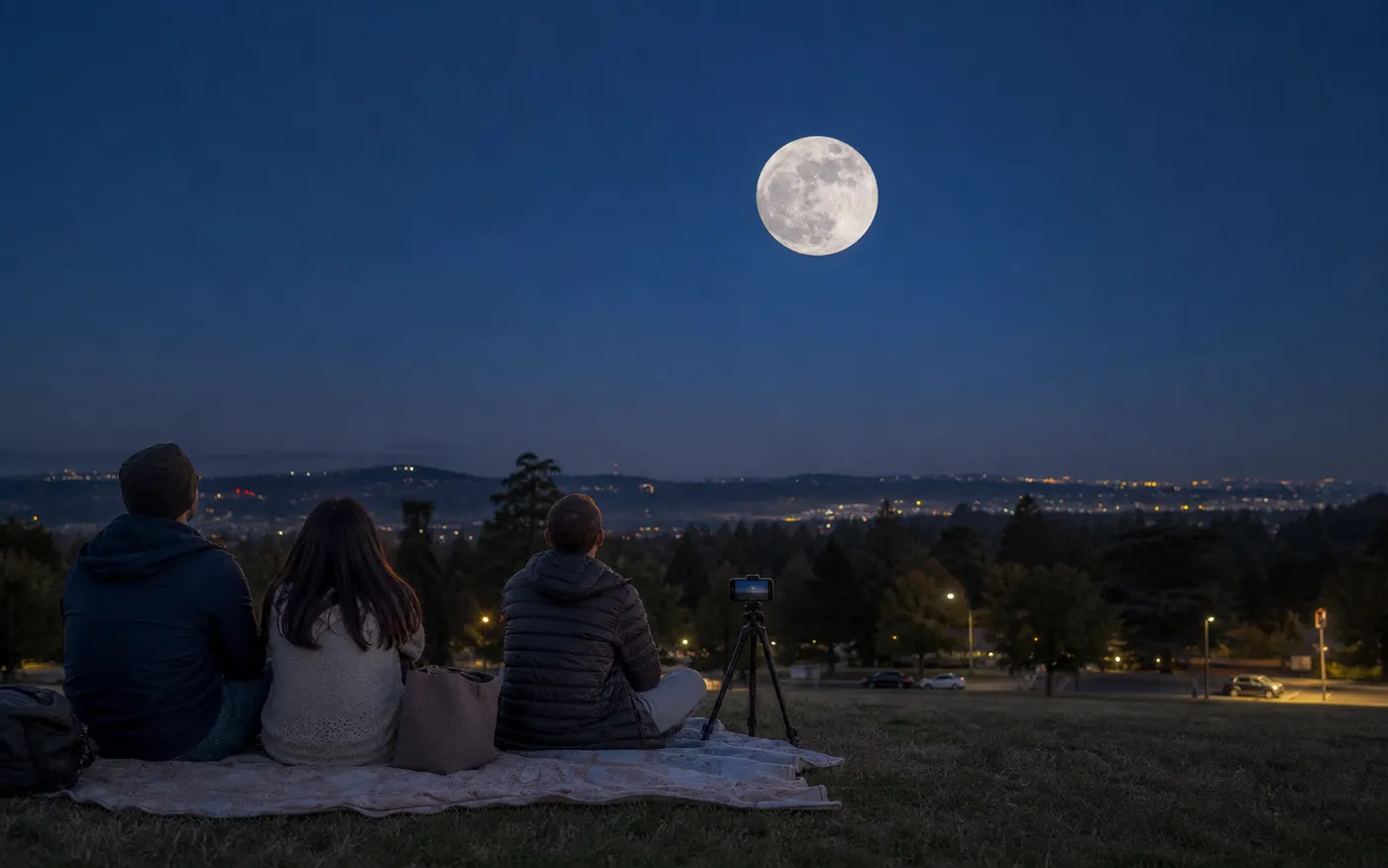
The May 31, 2026 Blue Moon is a good weekend skywatching target because it is easy to understand and easy to see if clouds cooperate. NASA's May skywatching guide says the month ends with a full Moon on May 31. Because May already had a full Moon earlier in the month, the May 31 full Moon is called a Blue Moon.
That name can be misleading. The Moon is not expected to turn blue. In normal conditions it should look like a familiar full Moon: bright, pale, and sometimes warmer near the horizon because you are seeing it through more of Earth's atmosphere.
What is the May 31, 2026 Blue Moon?
In this case, a Blue Moon means the second full Moon in a single calendar month. The Moon's phase cycle is about 29.5 days, while most calendar months have 30 or 31 days. If a full Moon falls very early in a long month, another full Moon can fit before that month ends.
NASA explains that May 2026 has that setup. The May 31 full Moon is the extra full Moon of the calendar month, so it gets the Blue Moon label.
There is also a seasonal definition of Blue Moon, based on the third full Moon in a season with four full Moons. That is not the common weekend use for this event. For May 31, the simple calendar definition is the one readers will see most often.
When should you look for the Blue Moon?
The full phase happens at a specific moment, but for casual skywatching the Moon looks full enough on the nights around the event. Timeanddate lists the May 31 full Moon at 08:45 UTC, which is early Sunday morning in the eastern United States.
For most viewers, the more useful question is not the exact full-Moon instant. It is local moonrise. The Moon is often easiest to enjoy and photograph when it rises low in the sky, especially if you can see a clear eastern horizon.
Use a local moonrise tool for your city, then plan to be outside a little before that time. If the eastern horizon is blocked by trees or buildings, give the Moon extra time to climb into view.
Why will the Blue Moon not look blue?
The phrase "Blue Moon" is mostly a calendar nickname. It does not describe the Moon's expected color.
A Moon can very rarely look bluish when smoke or dust particles in the atmosphere scatter light in an unusual way. That is not what makes the May 31, 2026 full Moon a Blue Moon. The label comes from timing, not color.
Near the horizon, the Moon may look yellow, orange, or gold. That is normal. It happens because moonlight travels through more atmosphere before reaching your eyes.
How to watch it without overthinking it
You do not need a telescope to enjoy a full Moon. A simple viewing plan works better:
- Check your local cloud forecast before heading out.
- Find a safe open spot with a clear view toward the east around moonrise.
- Let your eyes adjust and avoid staring at a bright phone screen the whole time.
- Bring binoculars if you have them, but expect glare because the full Moon is bright.
- If you are out with kids, point out that the Moon rises in the east and moves across the sky as Earth rotates.
Full Moon nights are bright, so they are not ideal for faint deep-sky objects. But they are excellent for a casual skywatching moment, a short walk, or a simple photo.
Phone-camera tips for the May 31 Blue Moon
Most disappointing Moon photos happen for two reasons: the phone overexposes the Moon into a white dot, or the photographer zooms so far that the image becomes mushy.
Try this instead:
- Lower the exposure. Tap the Moon and drag exposure down if your camera app allows it.
- Brace the phone. Use a tripod, railing, parked car, or both hands against a stable surface.
- Use foreground context. Trees, rooftops, water, a skyline, or a person looking up can make the photo more interesting than a tiny Moon in empty sky.
- Avoid extreme digital zoom. Modest zoom is usually cleaner than maximum zoom.
- Try video too. A short clip of the Moon rising can look better than a single still photo.
If you have a dedicated camera, use a tripod and experiment with fast shutter speeds. The Moon is brighter than many people expect, so night-mode settings can easily overdo it.
What if clouds block it?
A Blue Moon is not a one-minute event for casual viewers. If clouds block your exact local moonrise, check again later that night or around the surrounding nights. The Moon will still look nearly full close to May 31.
If the sky is completely covered, use the event as a reminder to mark the next few full Moons. Unlike an eclipse, a Blue Moon does not require a narrow viewing path or special safety gear.
What to tell someone who asks if the Moon will be blue
The simplest answer is: no, not because of the Blue Moon label. It is called a Blue Moon because it is the second full Moon in May 2026. It should look like a bright full Moon unless local sky conditions add unusual color.
That distinction matters because it keeps the event fun without overselling it. The reason to look is not that the Moon will become a different object. It is that the calendar has lined up in a way that gives May a second full-Moon weekend.
FAQ
What day is the Blue Moon in May 2026?
The Blue Moon is on Sunday, May 31, 2026.
Why is it called a Blue Moon?
It is called a Blue Moon because it is the second full Moon in a single calendar month.
Will the May 31, 2026 Blue Moon actually look blue?
No. The name comes from the calendar timing. The Moon usually looks white, gray, yellow, or orange depending on height and sky conditions.
Do I need a telescope to see it?
No. The full Moon is easy to see with the naked eye when skies are clear. Binoculars can be fun, but the Moon will be bright.
What is the best time to look?
Check your local moonrise time. Around moonrise is often the best viewing and photo window because the Moon is low enough to frame with the horizon.